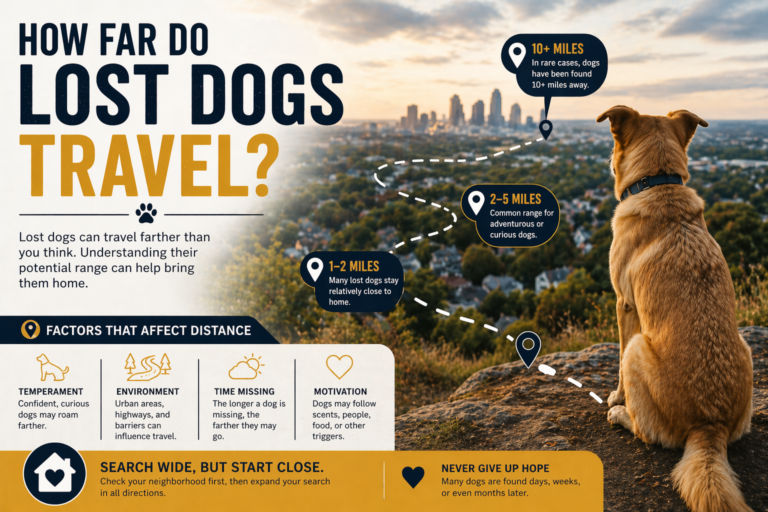
Some lost dogs remain within a few blocks of home, while frightened, chased, or continuously moving dogs may travel several miles. The distance depends more on the dog's emotional state, the escape trigger, the terrain, the time that has passed, and how people respond than on breed or size alone.
A friendly, wandering dog may be contained by the first person who stops. A fearful dog may avoid everyone and keep moving. Dogs often circle rather than travel in a straight line, so a fresh, verified sighting is usually more useful than a generic search radius. The goal is not merely to estimate mileage — it is to determine direction.
Some dogs stay close to home, especially in the first few hours.
Scared or continuously moving dogs can travel several miles.
Sightings and terrain — not a fixed circle — determine the real search area.
KC Pet Search & Rescue reviews the escape circumstances, dog behavior, sightings, terrain, and timing before recommending a next step. Every completed recovery form receives a free consultation, and getting organized early can help keep the search area from expanding.
There is no single distance that applies to every missing dog. These six factors matter more than breed or size.
Friendly, social dogs may approach the first person who stops and are often contained quickly. Fearful, aloof, or traumatized dogs are more likely to avoid people entirely and keep moving before accepting help.
Why scared dogs avoid owners →A dog following a scent may wander and double back near home. Fireworks, storms, traffic, accidents, or sudden fear are more likely to cause a straight-line panic run that covers real distance.
First-hour recovery steps →Chasing, shouting, calling loudly, following in a vehicle, or sending large groups into an area can trigger another flight response and push a dog beyond the original search zone.
How to approach a scared dog →Creek beds, wooded strips, fence lines, drainage routes, and rail corridors can become natural travel paths. Highways, rivers, and dense development tend to redirect movement rather than stop it outright.
Where lost dogs usually go →A dog moving overnight may cover more ground before anyone sees it, since traffic and foot activity drop off. During busy daytime hours, the same dog may hide, stop moving, or be reported more quickly.
Best search times →Dense neighborhoods often mean faster containment because more people are likely to see the dog. Farmland, industrial zones, and large wooded corridors can let a dog travel farther before anyone reports it.
Best way to find a lost dog →Some dogs hide close to the escape point or move through nearby yards, parks, and wooded edges. Protect that area and prevent chasing or crowding — this is the best window to keep the search small.
The dog may begin following quiet routes, fence lines, creeks, or low-traffic corridors. Early sightings can reveal direction and whether the dog is circling or traveling outward.
A frightened dog that keeps moving can travel several miles. A calmer dog may settle sooner, especially after finding shelter, food, water, or a place that feels secure.
Searching a fixed circle becomes less useful at this stage. Stop relying on radius alone — use verified sightings, mapping, cameras, terrain analysis, and a controlled recovery plan instead.
A lost dog may appear to move randomly, but the Kansas City metro's mix of terrain often creates connected routes that carry a frightened dog through several neighborhoods or across jurisdictions.
Two sightings that look far apart on a map may still be connected by a single wooded strip, creek, trail, fence line, or drainage corridor. Mapping the route between sightings is often more useful than drawing a simple radius around each location — wooded cover can give a frightened dog a place to rest, creeks and fence lines can become low-resistance travel routes, and busy roads or development tend to redirect movement rather than stop it.
When an owner finally sees a missing dog, the natural reaction is to call its name, move toward it, or follow it. A frightened dog may interpret that attention as pressure. Fear can temporarily override familiar behavior — a dog may recognize its owner's voice and still move away, refuse treats, avoid eye contact, ignore commands, or run from people it normally trusts. That does not mean the dog no longer knows or loves its family. It means the dog is reacting to perceived danger, and the recovery strategy has to reduce pressure long enough for it to slow down, settle, and feel safe.
"Near the park" is not enough. A precise sighting can support movement mapping, travel-corridor evaluation, thermal search planning, camera placement, and the recovery decision itself.
When a missing dog may be several blocks or several miles away, walking neighborhoods and searching from the ground can only cover so much territory. Visibility is limited, wooded edges hide movement, and every hour can let the search area grow. Thermal drone search is one of KC Pet Search & Rescue's strongest large-area location tools when terrain, weather, airspace, and current sighting information are suitable — not a universal fix for every case.
Scans fields, parks, creek corridors, wooded edges, and large properties far faster than searching on foot.
Inspects fields, wooded edges, creek systems, and large properties that are slow or unsafe to cover on the ground.
Reveals heat under brush, along tree lines, or in low-light conditions that ground searchers may miss.
Searching from above can reduce the need to send large groups into a dog's hiding area.
From the air, connected fence lines, creeks, wooded strips, and open fields can be assessed quickly.
Supports a controlled recovery response based on where the dog is right now, not where it was hours ago.
KC Pet Search & Rescue does not simply tell owners to search harder. We help determine where the dog may be moving, how the terrain affects the search, which sightings matter, when thermal drone search is appropriate, and what should happen next.
Turn scattered calls, messages, posts, and comments into one usable movement timeline.
Evaluate roads, creeks, fields, wooded corridors, fences, and likely travel paths.
Search suitable large outdoor areas efficiently and reduce unnecessary ground pressure.
Help determine what should happen after the dog is located or confirmed.
Every completed lost-dog recovery form receives a free consultation from KC Pet Search & Rescue.
A real thermal drone search case from Olathe, Kansas — another verified field recovery, not a stock demonstration.
Izzy and Callie are two of many documented KC Pet Search & Rescue field cases. Explore the full library for more real recoveries.
Explore the Dog Recovery Video LibraryFamilies across the Kansas City area have trusted KC Pet Search & Rescue for calm guidance, advanced search tools, and structured lost-pet recovery support.
"The best search and rescue there is! He helped us find our pup before the fireworks got too loud on the 4th of July."
— GK, Missing Dog Recovery
"Jay was able to use his services with his drone to detect motion and visuals in the area where Buoy's AirTag was pinging."
— Haley Pitcairn, Buoy's Recovery
"He came out on a holiday to help us find our dog. Jay really cares about your family, your lost animal, and the service he provides."
— Amber Stephens, Lost Dog Search
Posting in the correct local groups can help generate sightings. Keep public posts safe: do not chase, do not call out — report the exact location, time, and direction, and include photos or video when possible.
Professional recovery is not simply adding more people. It is creating a controlled plan — and it is most valuable before the search becomes disorganized.
The dog is still moving
Sightings are spreading out
The dog runs from everyone
Terrain limits ground searching
The search area keeps growing
Information is disorganized
The same places are checked repeatedly
Hours pass with no confirmed location
Every submitted lost-dog recovery form receives a free consultation, reviewed before you commit to any service.
Every dog and every disappearance is different. These answers cover the questions Kansas City owners ask most when trying to understand movement and decide what to do next.
Some dogs remain within a few blocks of home, while others travel several miles. Temperament, the escape trigger, terrain, weather, time of day, and human pressure all affect distance.
A frightened or continuously moving dog can travel several miles in 24 hours. A dog that finds cover, food, water, or a quiet place may settle much sooner. The latest verified sighting is usually more useful than a general mileage estimate.
Many dogs begin close to the escape point, but that does not guarantee they will stay there. Dogs may circle, hide nearby, follow a scent, or leave the area after being chased or frightened.
Yes. Size is not the deciding factor. A small dog in flight mode can cover significant distance, especially through connected cover like fence lines, creeks, and quiet residential streets.
Older dogs often move more slowly and may stay closer to home, but fear and adrenaline can still carry an older dog farther than expected, particularly in the first hours after a frightening escape.
Some do. A dog may loop through familiar-smelling areas rather than travel in a straight line, which is one reason sightings near the escape point remain valuable even hours later.
Many frightened dogs move during quieter evening, overnight, or early-morning periods when traffic and human activity decrease, which can allow a dog to travel farther without being seen.
Yes. Running toward the dog, following it in a vehicle, surrounding it, or sending large groups into the area can trigger another flight response. A sighting should be protected rather than turned into another chase.
A small initial radius can help, but a perfect circle does not account for terrain, barriers, or travel corridors. Once sightings occur, the route between them is often more important than the original radius.
Exact location, exact time, direction of travel, and behavior. A precise sighting can support movement mapping and recovery planning far better than a general description.
Thermal drone search is especially useful when the dog may be in fields, wooded edges, parks, creek corridors, or other large outdoor areas where ground visibility is limited, and when the search area is expanding and needs to be checked quickly.
No. Thermal cannot see through solid structures, and heavy vegetation or dense cover can reduce visibility. Weather and temperature contrast also affect results.
No search method can guarantee a location. Thermal performance depends on terrain, vegetation, weather, legal flight access, the quality of sighting information, and whether the dog is within the searched area. It remains one of the strongest professional tools for covering large outdoor areas efficiently.
Contact KC Pet Search & Rescue when the dog is still moving, sightings are spreading out, the dog runs from people, terrain limits visibility, or the search lacks a coordinated plan.
Yes. Every submitted lost-dog recovery form receives a free consultation reviewing the dog's behavior, escape circumstances, sightings, terrain, and timing before recommending a next step.
KC Pet Search & Rescue serves the greater Kansas City metro, including surrounding Kansas and Missouri counties. Visit the Emergency Pet Recovery Hub for full coverage details.
A lost dog may remain close, move miles, circle back, or settle in terrain owners cannot search effectively from the ground. The answer is not always more people, more calling, or a larger search circle. The answer is better information, a focused search area, the right technology, and a controlled recovery plan. KC Pet Search & Rescue helps Kansas City families put those pieces together, and every submitted recovery form receives a free consultation.