Dog Trapping Support • Kansas City Metro
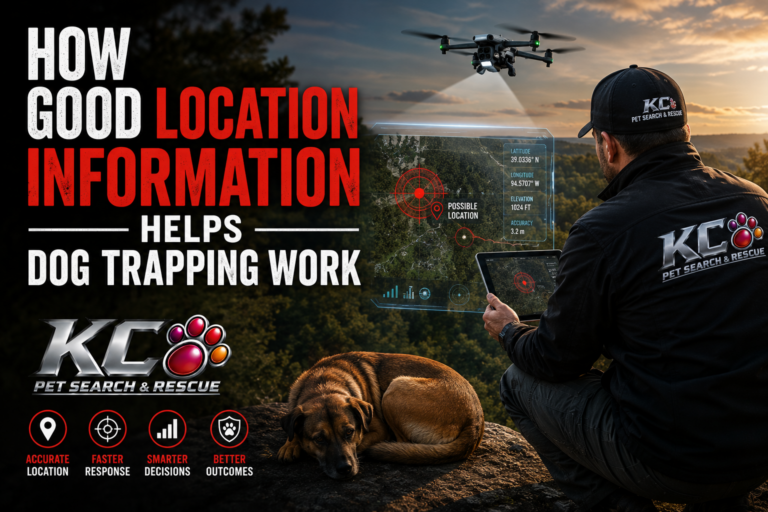
Good information can make a lost dog recovery effort far more organized. When owners search for dog trapping Kansas City, dog trapping near me, or dog trapper near me, they often need more than a tool — they need clearer information about where the dog has been seen, where it may be moving, and whether the area being focused on is actually the right one.
A dog trap works best when the dog is actually using the area, returning to the area, or moving through the area consistently.
KC Pet Search & Rescue helps with the search-information side of the recovery effort through thermal drone search, fresh sighting response, tracker ping response, and location documentation. We do not represent ourselves as a dog trapping company, and we do not direct dog trapping operations. Our role is to help owners build a clearer picture of the dog’s location, movement pattern, terrain, and recent activity.
Serving Kansas City, Olathe, Overland Park, Lenexa, Shawnee, Leawood, Gardner, Kansas City Kansas, Lee’s Summit, Independence, Blue Springs, Raytown, Liberty, Gladstone, Parkville, Belton, Raymore, and surrounding metro areas.
Before the Recovery Plan Depends on a Location
A dog trap may be part of a lost dog recovery effort, but the information around the dog matters first. In Kansas City lost dog cases, fresh sightings, movement patterns, tracker pings, terrain, and human pressure can all affect how useful a location really is.
A sighting does not always mean the dog is staying there. The dog may be passing through, circling back, hiding nearby, or already moving toward another area.
A sighting from ten minutes ago and a sighting from two days ago should not be treated the same. Timing matters when a scared dog is moving.
Woods, creek lines, fences, roads, fields, apartment complexes, industrial areas, and quiet travel corridors can all change the search picture.
Chasing, calling, crowding, and people gathering near sightings can cause a scared dog to leave an area or change its movement pattern.
Multiple sightings, social media comments, tracker locations, and neighborhood reports need to be organized so the owner can focus on the most reliable information.
Thermal drone search, visual checks, and careful documentation can help owners understand what areas have been searched and what still needs follow-up.
In a lost dog recovery effort, the goal is not just to pick a location. The goal is to understand whether the dog is actually using that area, moving through it, returning to it, or avoiding it because of pressure.
This is why good location information matters. It helps owners separate a useful lead from a guess.
Not all sightings or pings carry the same weight. A stronger location usually has details that can be checked, documented, and compared with other information.
Movement Patterns and Pressure
In a dog trapping near me or lost dog recovery situation, a map pin is only the beginning. The stronger question is whether the dog is traveling through the area, hiding nearby, circling back, avoiding pressure, or only passing through once.
A scared dog may not move in a straight line. It may circle, pause, hide, double back, follow cover, avoid open areas, or travel during quieter times. Good location information helps owners look for patterns instead of reacting to every report as a separate emergency.
A location may be useful one hour and less useful the next if too much pressure is added. People rushing into the area, yelling, following, or posting exact live locations can cause a scared dog to move differently.
The dog may have been seen in an area but may not be staying there or returning consistently.
Some scared dogs revisit familiar areas, food sources, scent points, or quiet routes.
Woods, brush, sheds, decks, creek lines, and quiet property edges may hide a dog close to a sighting.
Human activity can push a dog away from an otherwise useful location.
Sightings • Pings • Thermal Follow-Up
In a dog trapping Kansas City or lost dog search situation, a fresh sighting, AirTag ping, GPS tracker location, or neighbor report can be extremely valuable. But that information is strongest when it is followed up calmly, documented clearly, and checked without pushing the dog away.
A fresh sighting can help narrow the search area, but the exact point is only part of the picture. The dog may have moved into nearby cover, crossed a road, followed a fence line, or continued through the area.
Tracker pings can be useful leads, but they are not always exact recovery points. The surrounding area may need careful visual follow-up, especially around fields, woods, apartments, parks, or industrial lots.
Thermal drone search may help check areas that are hard to search on foot, especially when there is a recent lead and a reasonable area to scan. It is a search tool, not a guarantee.
A strong lead usually has enough detail to help narrow the search area and understand what the dog may have done next.
A good lead can lose value if too much pressure is added before the area is understood. This is common when many people rush toward a live sighting.
Terrain and Location Context
In a dog trapping near me or dog trapping Kansas City search, the exact sighting point matters — but so does everything around it. Terrain, cover, barriers, water, traffic, and quiet routes can all affect how a scared lost dog moves through the area.
Woods, brush, tall grass, sheds, decks, drainage areas, and creek lines can allow a scared dog to stay close while remaining hidden.
Fences, highways, railroad tracks, locked gates, water, and heavy traffic may influence where a dog can or cannot travel.
Some lost dogs avoid busy sidewalks and may use creek beds, tree lines, utility cuts, field edges, or low-traffic corridors.
Water sources, trash areas, feeding stations, outdoor pet food, and familiar scent locations may influence whether a dog returns.
A sighting beside a road, park, field, apartment complex, or wooded area may mean different things. The dog may be passing through, hiding nearby, using a travel corridor, or reacting to pressure from people.
This is why KC Pet Search & Rescue looks beyond the pin on the map. The search area around the sighting can help explain what may be happening.
Our role is to help owners gather better search information. Terrain notes, fresh sightings, tracker pings, and thermal search results can create a clearer picture of where a scared dog may be moving.
Location Documentation
When owners search for dog trapping near me, dog trap placement help, or lost dog search support, the situation is often already stressful. Good documentation helps separate confirmed facts from guesses, old sightings, and social media noise.
Confirmed sightings should include the time, location, direction of travel, dog behavior, and whether a photo, video, or camera clip exists.
Possible sightings can still be useful, but they should be marked differently than confirmed information so the owner does not chase every report equally.
Search notes help owners avoid repeating the same effort over and over while missing other areas that may still need careful follow-up.
A stronger recovery picture comes from details that can be reviewed, compared, and shared clearly with the people involved in the search.
Many lost dog cases become harder because too much unorganized information starts coming in at once. That can lead to panic searching instead of focused follow-up.
Kansas City Dog Trapping Location Support
When owners search for dog trapping near me, dog trapping Kansas City, or dog trap placement help, the real need is often clearer information. A scared lost dog recovery is easier to organize when sightings, tracker pings, terrain, movement patterns, and pressure around the dog are documented instead of guessed.
KC Pet Search & Rescue helps with the search-information side of the process through thermal drone search, fresh sighting response, AirTag and GPS tracker ping response, and location documentation. Dog trapping remains a separate recovery method handled by dog trappers or trapping groups.
Lost dog search support across Kansas City, Olathe, Overland Park, Lenexa, Shawnee, Leawood, Gardner, Kansas City Kansas, Lee’s Summit, Independence, Blue Springs, Raytown, Liberty, Gladstone, North Kansas City, Parkville, Belton, Raymore, and surrounding metro areas.
KC Pet Search & Rescue Resource Directory
These related resources help Kansas City pet owners understand dog trapping location information, scared dog behavior, thermal drone search, fresh sightings, tracker pings, and organized lost dog recovery support.
Learn how dog trapping, lost dog search support, sightings, and thermal drone search can fit into a scared dog recovery effort.
See how search support, fresh sighting response, tracker ping response, and location documentation can support a larger recovery effort.
Emergency lost dog search help for fresh sightings, tracker pings, thermal drone search, and scared dog recovery support.
View KC Pet Search & Rescue lost dog services for Kansas City area owners needing urgent search and recovery support.
Explore Kansas City lost pet recovery services, city pages, county pages, and owner recovery resources.
View broader recovery services including lost dog search, lost cat recovery, thermal drone search, and owner support.
Learn why scared dogs avoid people, what actions can make things worse, and how a calmer recovery approach can help.
Understand why a lost dog may run from the owner, ignore familiar voices, or stay hidden even when nearby.
The first hour matters. Learn what to do immediately and what to avoid when a dog first gets loose.
Learn where lost dogs may hide, travel, circle, or return around Kansas City neighborhoods and green spaces.
Understand how distance, terrain, fear, traffic, and sightings can affect where a lost dog may move next.
A step-by-step guide for organizing sightings, search areas, flyers, posts, and recovery updates.
See how thermal drone search can help check fields, woods, creek lines, rural edges, parks, and hard-to-search areas.
Kansas City thermal drone search support for lost pets, fresh sightings, and possible location leads.
Night search requires a different approach. Learn how darkness, quiet, sightings, and thermal search can change the plan.
Browse lost dog, lost cat, thermal drone, and pet recovery education built for Kansas City owners.
A step-by-step strategy for owners trying to organize sightings, reduce pressure, and search smarter.
Learn what to look for when choosing thermal drone pet search help in the Kansas City metro.