
Lost Indoor Cat in Kansas City?
KC Pet Search & Rescue provides thermal ground scanning, thermal drone search, and humane cat trapping to locate and safely recover hidden cats.
Serving Kansas City, Johnson County, Olathe, Overland Park, Lenexa, Shawnee, Liberty, Blue Springs, Independence, Lee’s Summit, and surrounding areas.
📞 Call Now: 913-915-2800When an indoor cat gets outside, they usually do not run far — they hide.
Most escaped indoor cats stay close to the home at first. The problem is they hide so well that owners walk right past them. They may not meow. They may not come when called. They may stay frozen in fear only a few yards away.
If your indoor cat is missing outside, the fastest path is not random searching. It is a controlled recovery plan using close-area search, thermal ground scanning, scent placement, camera monitoring, and humane cat trapping.
Indoor Cat Got Outside?
KC Pet Search & Rescue can help with thermal ground scanning, scent strategy, camera monitoring, and humane cat trapping.
Call Now: 913-915-2800Indoor cats are not used to outdoor danger, traffic, wind, dogs, people, and unfamiliar noise. When they escape, many go into survival mode and hide in the first covered place they can reach.
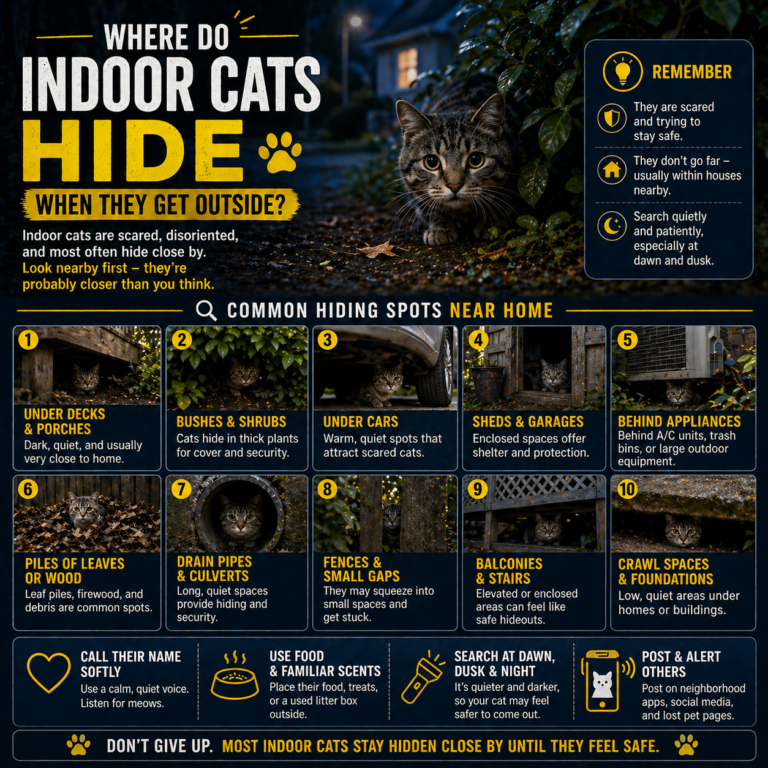
Common hiding spots include:
The cat may be close enough to hear you, but too scared to respond.
Outside, your cat may not act like the cat you know indoors.
Fear can cause an indoor cat to:
This is why calling, shaking treats, and walking the neighborhood often fails. The cat is not ignoring you. The cat is scared.
One of the best early recovery tools is a thermal ground scan.
A thermal monocular can help check areas that are difficult to see with the naked eye, including under decks, brush lines, sheds, bushes, and tight covered spaces.
This matters because many escaped indoor cats are hiding close, but visually blocked. A thermal scan can help confirm whether a heat signature is present without pushing the cat farther away.
If your cat is hiding and will not come out, humane trapping may be the safest and most effective solution.
This is not just putting a trap in the yard and hoping. A professional trapping setup uses:
Cat trapping works especially well when the cat is still nearby but too scared to approach people.
Seen your cat but can’t catch them?
That is exactly when monitored humane trapping becomes the right move.
Get Cat Recovery HelpSome do, but many escaped indoor cats hide during daylight and move after the neighborhood gets quiet.
The most common movement windows are:
This is why cameras are so important. Your cat may be returning to the same area at 2:00 a.m. while everyone thinks they are gone.
For some cases, a thermal drone can help scan yards, tree lines, open areas, drainage paths, and nearby properties faster than walking alone.
Thermal drone search is not always the first tool for every indoor cat case, because many cats hide under cover. But when the search area needs to expand, or when there is a recent sighting, thermal drone support can help identify possible heat signatures and movement areas.
The strongest approach is using the right tool at the right time: ground thermal scan near the escape point, scent and camera strategy to confirm activity, and humane trapping to complete the recovery.
Do not chase your cat if you see them. Do not send a crowd of people through nearby yards. Do not scatter food all over the neighborhood.
Those actions can make the cat move farther away or make the recovery harder.
The goal is to keep the cat close, calm, and moving toward one controlled recovery point.
This is the difference between guessing and running a recovery plan.
KC Pet Search & Rescue helps recover escaped indoor cats across the Kansas City area using thermal ground scans, scent strategy, camera monitoring, humane cat trapping, and thermal drone support when needed.
If your cat is hiding outside, early action matters. The longer the situation goes uncontrolled, the more difficult recovery can become.
Your cat may still be close. Let’s recover them before they move farther.
Call now for indoor cat recovery, thermal ground scanning, and humane cat trapping in the Kansas City area.
Call 913-915-2800Indoor cats usually hide close to the escape point in low, covered areas such as under decks, porches, sheds, bushes, vehicles, crawl spaces, and dense landscaping.
Some indoor cats return on their own, usually at night, but many stay hidden because they are scared. Controlled scent placement, cameras, and trapping may be needed.
The best approach is to search close, use a thermal ground scan when needed, monitor with a camera, and use humane trapping if the cat will not come out.
No. Chasing can push a scared cat farther away. Stay calm and use a controlled recovery approach instead.
Call for help if your cat has been seen but will not approach, is moving only at night, keeps returning to food, or is hiding in an area you cannot safely access.
Indoor cats typically stay extremely close after escaping. These additional recovery guides explain common hiding behavior, nighttime movement patterns, thermal drone search strategy, and emergency recovery steps used throughout the Kansas City metro.
Learn how thermal drone deployment, ground thermal scanning, and structured recovery strategy help locate escaped indoor cats quickly.
The first few hours matter most. Avoid common mistakes and learn the exact recovery actions that improve your chances of getting your cat back safely.
Explore emergency dog and cat recovery resources, service areas, thermal recovery strategy, and recovery education for the Kansas City metro.
Missing dogs behave differently than escaped indoor cats. Learn how thermal drone deployment and live recovery coordination work during emergency searches.
Many indoor cats are located within a very small radius of the escape point — often hiding silently under decks, brush, sheds, vehicles, or dense cover for hours or even days before moving.
Emergency Cat Recovery AssistanceEvery search is different. Some pets are located within minutes while others require advanced thermal search strategy, owner coordination, night operations, trapping plans, and multiple recovery attempts. These real recovery stories show how missing pets are successfully located throughout the Kansas City metro.
Learn how thermal scanning, silent search patterns, and owner-guided recovery strategy help locate indoor cats hiding close to home.
Real-world recovery coordination using thermal drones, live owner communication, and structured pursuit strategy during an active search.
Recovery videos, reunions, owner updates, and community support stories from pet owners throughout Kansas City and surrounding areas.
Lost dogs and escaped indoor cats often behave very differently than owners expect. Early recovery strategy, thermal technology, and structured response dramatically improve the chances of successful recovery.
Every lost pet situation requires a structured response strategy. From emergency deployment and thermal drone operations to owner-guided recovery and advanced trapping support, each step is designed to improve visibility, reduce search errors, and increase the chances of safe recovery.
Recovery begins with understanding the pet’s behavior, escape timeline, environment, sightings, and likely movement patterns. Indoor cats and frightened dogs behave very differently after escaping.
FAA-certified thermal drone operations scan large areas rapidly while identifying heat signatures that are difficult or impossible to detect visually at night or in dense cover.
Thermal monocular scanning helps inspect decks, brush lines, culverts, woodlines, vehicles, drainage areas, and other hiding locations commonly used by escaped indoor cats.
Once a pet is located, owners are guided in real time using phone communication, GPS orientation, thermal overwatch, and recovery strategy to reduce the chance of spooking the animal.
Some indoor cats require structured trapping strategy with scent anchoring, monitored traps, bait rotation, trail cameras, and controlled recovery planning over several days.
Recovery efforts do not always end after the first deployment. Return searches, sighting response operations, and updated recovery plans are often critical to successful outcomes.
Lost dogs and escaped indoor cats behave differently depending on fear level, environment, weather, traffic, scent contamination, and human interaction. These recovery guides answer the most common questions asked by pet owners across the Kansas City metro.
Many lost pets are unintentionally pushed farther away due to panic response, excessive searching, scent contamination, or recovery mistakes. Understanding real pet behavior is one of the most important parts of successful recovery.
Most escaped indoor cats do not immediately travel long distances. Instead, they often enter a fear-based survival state and hide silently in extremely tight, concealed locations very close to the original escape point.
Indoor cats frequently crawl beneath decks, porches, and stair structures where they feel protected from movement, noise, and predators.
Thick landscaping, overgrown vegetation, and brush lines provide concealment while allowing cats to observe surroundings without exposing themselves.
Warm engines, shadows, and low visibility make parked vehicles one of the most common temporary hiding locations during the first several hours.
Firewood stacks, outdoor storage zones, and cluttered backyard areas create dark hiding spaces that many owners accidentally overlook.
During rain, wind, or cold weather, indoor cats may relocate into storm drains, culverts, or covered drainage structures for shelter.
Many indoor cats remain hidden during daylight hours and move cautiously at night when neighborhoods become quieter and safer.
One escaped indoor cat in the Kansas City metro was located less than 70 feet from the original escape point after remaining hidden silently beneath a neighboring deck for over 36 hours. Situations like this are extremely common with indoor-only cats experiencing outdoor survival stress for the first time.
Most escaped indoor cats do not immediately disappear. They often hide silently nearby while owners unknowingly search too far away. Early recovery strategy, thermal technology, and structured search planning can dramatically improve the chances of successful recovery.