KC Pet Search & Rescue • Olathe, Kansas
A frightened golden retriever had been missing for approximately nine hours in dangerously cold conditions. With roughly 70 people searching, KC Pet Search & Rescue deployed thermal-drone support, located Buoy in just over 30 minutes, and helped coordinate the ground team that brought him home.
Watch the recovery
This is the recovery as it happened: a frightened dog moving through difficult terrain in Olathe, an aerial team keeping awareness of where he was, and ground rescuers being directed toward his confirmed position.
Buoy’s Olathe Recovery — KC Pet Search & Rescue 5 minutes 23 seconds • Olathe, Kansas
Watch on YouTube ↗More real cases are collected in the dog recovery video library.
Every missing-dog case is different. Terrain, weather, recent sightings, the dog’s behavior, and the amount of time missing all affect the recovery plan.
KC Pet Search & Rescue provides professional lost-dog search and recovery support throughout the Kansas City region and evaluates select surrounding-area missions based on distance, conditions, airspace, and availability.
How it started
Buoy is a nine-month-old golden retriever, roughly 75 pounds, and by every ordinary measure an easy dog to be around. A loud noise at home changed that in a second. He bolted, and the young, friendly, normally responsive dog his family knew was replaced by an animal running on instinct.
Fear does not make a dog forget his family. It makes him stop reading them as safety. By the time the search was fully underway, Buoy had been gone for hours — and he was still on the move.
Conditions made the clock heavier. Temperatures kept dropping. By then, Buoy had been missing and on the run for approximately nine hours in frigid conditions.
The community response was extraordinary — roughly 70 people, in cars and on foot. But a large search is not an informed one. Seventy people still could not say where Buoy was right now, and every minute he kept moving, the area to cover grew.
A large ground search can still lose track of a frightened moving dog. KC Pet Search & Rescue added aerial awareness and coordinated tracking to a response that already had plenty of people in it.
Narrowing the search
Buoy was wearing an AirTag, and its pings were doing useful work: they kept indicating a general area, which is more than most searches get. What a tag of that kind does not give you is a live position on a dog who is still traveling, or the direction he took next.
KC Pet Search & Rescue deployed thermal-drone support into that area. From the air, motion, visual, and thermal information can be read across ground people cannot cover quickly — treelines, drainage, the dark edges between properties — narrowing the active search to where a dog actually is.
Buoy was located in just over 30 minutes after that deployment began.
Together, the AirTag pings and aerial search complemented one another: the pings narrowed the general area, and the aerial search located Buoy within it. Neither tool guarantees the same result in every case.
An important distinction
Locating Buoy was not the end of the recovery — it was the point at which the search finally knew where he was. Within minutes, it nearly came apart.
The turning point
With Buoy’s position known, his owner was able to get close. Approximately ten feet separated them. For anyone who has ever lost a dog, that is the moment the ordeal is supposed to end.
Buoy ran.
It is worth being direct about what that was. It was not rejection, and not a failure of training or of the bond between them. A dog in flight for hours in the cold is running on survival behavior, and survival behavior makes no exception for the people it loves. Sudden closeness reads as pressure.
Under most circumstances that moment resets a search to zero — a new direction, a new area, hours of covered ground made useless.
It did not here, because KC Pet Search & Rescue still had aerial awareness of the search. Thermal tracking continued as Buoy moved through the wooded terrain, so the team did not have to start over blindly. The search had lost its easy ending; it had not lost the dog.
The coordinated response
Buoy moved into the hardest ground available to him: woods, a ravine, and thick vegetation. That terrain is where a ground search loses a dog — cover breaks sightlines within a few feet, and a moving dog opens distance faster than searchers can close it.
KC Pet Search & Rescue continued tracking from the air through that terrain, relocating and reacquiring Buoy as he moved. Once his position was confirmed and monitored, that became something the people on the ground could act on.
Ground rescuers were guided to his location. They approached calmly — the entire skill at that stage, because a rushed approach would simply have started the chase again — and completed the physical recovery.
Who did what matters. The aerial work located Buoy, kept awareness of him through difficult terrain, and directed the response. The ground team reached him and brought him out. Neither half recovers a dog without the other.
Located Buoy, tracked his movement, confirmed his position, and directed the response.
Moved in on the confirmed position, approached calmly, and physically recovered him.
Roughly 70 people kept the search alive through nine hours of cold.
The outcome
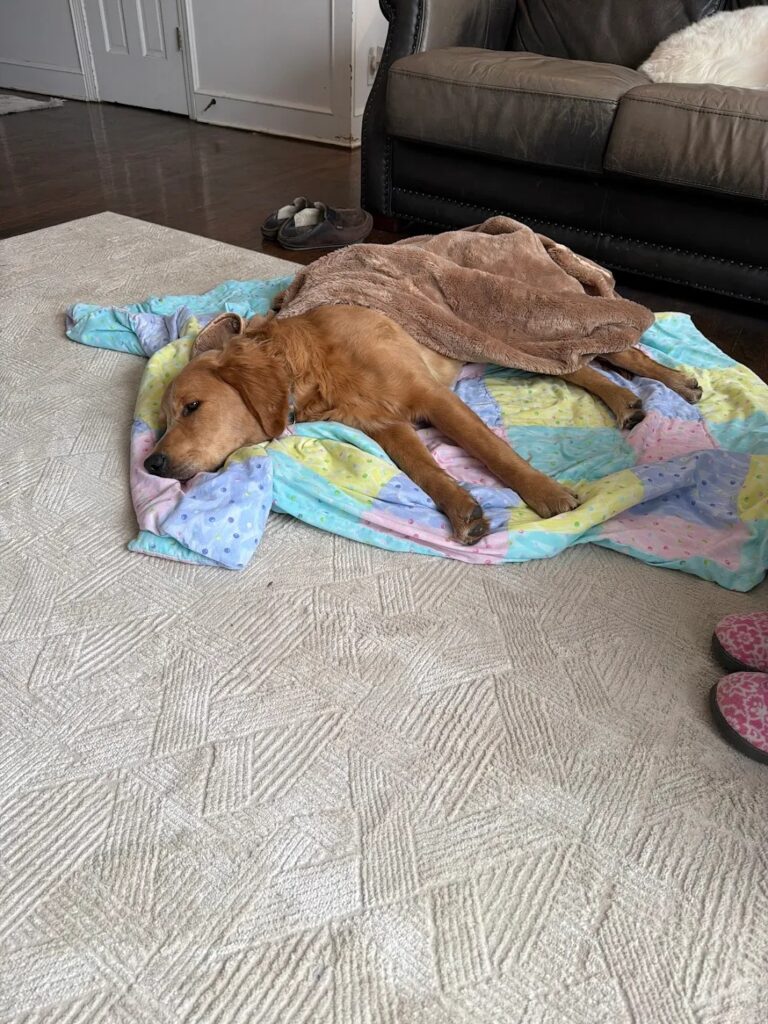
Buoy was brought back to his owner. After approximately nine hours missing in frigid conditions, that is the whole point of the work.
Buoy was evaluated by a veterinarian after the recovery. His owner reported that his vitals came back normal, that his paw pads were treated with antibiotics after his time out on hard ground, and that he was given medication for soreness and fatigue.
Before long he was eating and drinking, wagging his tail, and sleeping near the fire. None of that is veterinary advice, and none of it describes what any other dog will need — it is what this family reported.
The aftermath
After the recovery, Buoy’s owner posted a public thank-you. It belongs in the record of this case, because it captures something a search log never does.
The post showed Buoy safely home beside a thank-you card, alongside handwritten notes of gratitude filling page after page, addressed to people the family had not been able to thank in person.
The response was substantial: 691 reactions, 45 comments and 13 shares when the screenshot was captured.
The thanks were spread widely and deliberately: to the neighbors who drove and walked their own streets, to the searchers on foot in the cold, to everyone who posted and shared until the right person saw it, to KC Pet Search & Rescue for locating Buoy and reacquiring him as he moved, and to the men who went into the water and wooded ground to bring him out.
It took all of it. No single part of that night would have been enough alone.
In their words
Short excerpts from Google reviews left by Buoy’s owner, his family, and a family friend who was part of the search that night. Each is quoted as written.
“Jay was so kind, patient and was not going to give up til we got my baby home.”
“He was able to locate the dog, follow the dog with the drone as people moved on foot … and were able to get the dog.”
“If I had it to do all over again, he would be my 1st call.”
What it teaches
Observations from one recovery in Olathe, Kansas — not a protocol that fits every dog, every terrain, or every night.
Buoy ran with his owner about ten feet away. Fear can override a dog’s usual response, even when someone familiar gets close.
Roughly 70 people were looking and still could not say where Buoy was. Effort and location awareness are different resources.
A sighting or tracking read from ten minutes ago outweighs a thorough search of where a moving dog was two hours ago.
Its value here was giving the people walking the ravine a confirmed position to move toward.
Calling and closing in fast are the hardest instincts to resist and the most likely to push a dog further out.
Terrain, temperature, traffic, injury and access all raise the stakes. When several are in play at once, that is the point to bring in recovery assistance.
Serving this area
KC Pet Search & Rescue works this area regularly and knows how a frightened dog moves through it — the wooded creek corridors, the ravines behind subdivisions, the cover that swallows a dog within a few feet of a walking searcher.
The same help is available across Olathe, the rest of Johnson County, and the wider Kansas City metro. The lost dog recovery service page explains how a case is actually run, and the thermal-drone recovery page covers what aerial search can and cannot do, including when it is not the right tool.
Buoy’s case is not the only one on record. Callie’s recovery in Olathe was a different search with a different dog, and the dog recovery video library collects real cases across the metro. If your dog is missing now, start with the emergency dog recovery form.
Get help now
A frightened dog can keep moving even when family members get close. KC Pet Search & Rescue helps families develop a coordinated recovery response using current sightings, terrain analysis, thermal-drone support when appropriate, and ground-team communication.
Every submitted recovery form receives a free initial consultation.
No one can promise an outcome, and anyone who does is not being straight with you. What a coordinated response changes is how well informed the search is while there is still time to use it.
Because Hope Doesn’t Bring Them Home.